

Vacuum tankers
3,500 gallon capacity, so the biggest tanks and traps in the city clear in one trip.

Pump trucks when the tank has access. Confined-space crews and portable equipment when it doesn't. Pumping, cleaning, and tank maintenance, building by building.
Tell us the address and what needs service. We'll get back to you with a quote.
"3,500 gallons of your dirtiest, smelliest sewage waste, eliminated." That was our line thirty years ago and it still is.
Different tanks, same first job: remove the waste, clean what the pumps and outlets depend on, and get the tank back into service.
We send a pump truck when the tank has truck access. When it does not, the confined-space crew goes in with portable equipment.
A dosing pump meters treatment into an ejector pit on a set schedule. We set up the pump, refill the treatment, and service it with the tank.
Float balls and rods tell an ejector tank when to run the pump. When they stop moving the way they should, we replace them so the tank can operate normally.
Some sites need a pump to stay in place for an extended period. We install gasoline or electric portable pumps, matched to the access and available power.
We offer septic tank treatment, but we usually advise against using an additive as the answer. Nothing in a bottle removes the solids already in the tank.
3,500 gallon capacity, so the biggest tanks and traps in the city clear in one trip.
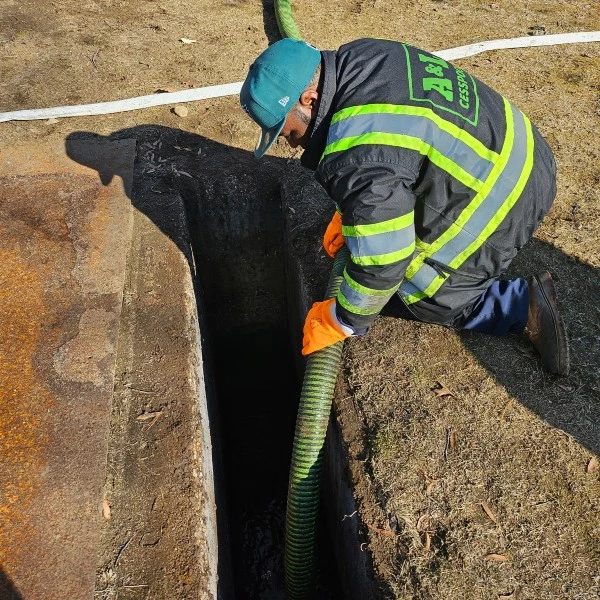
A septic tank pumped in a Queens side yard, hose off the tanker.
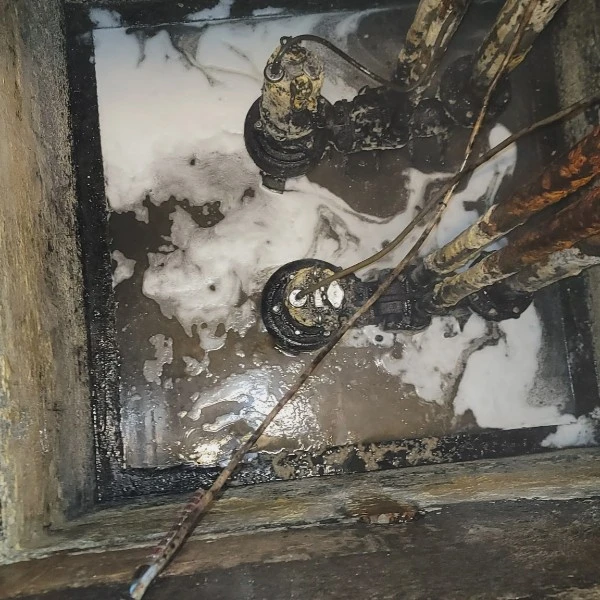
An ejector pit after cleaning: pumps visible, walls bare, ready for service.
“We live in Queens and have a cesspool. Not a lot of companies do this still in Queens, but glad I found them. They are very helpful, professional and timely. They were very punctual and arrived at my house at 3 PM to pump.”
“When my commercial space started backing up water, A&L saved us. No one knew what was causing it, and their techs were able to trace it all and fix the problem on the spot. They were able to trace it back to an issue with the municipal system, and saved me thousands.”
“Their office found us the earliest possible appointment each time we called, their techs have always arrived during the expected window, were clear when explaining what they were doing, and when the camera was run they walked us through the video and their findings. They'll be my first call from now on.”
Most systems run three to five years between pumpouts; heavy use runs shorter. We measure the sludge level and set the schedule off what's actually in the tank.
Slow drains, gurgling, sewage smell, damp ground over the system, or a backup. Any of those, call before it gets worse.
A cesspool stores and seeps. A septic system separates solids and sends the liquid to a drain field. Pre-1970 buildings off the city main usually have the former.
No. We offer septic tank treatment, but usually advise against treating an additive as the answer. Pumping comes first.
That's most of the route. Schools, agencies, and building portfolios run on schedules, building by building.
Call dispatch with the address and what's backing up. For scheduled service, send the quote form and we'll come back with the cycle.